
Part of the Smart Home Saga – a four five-part look at my ongoing truce with Google Nest.
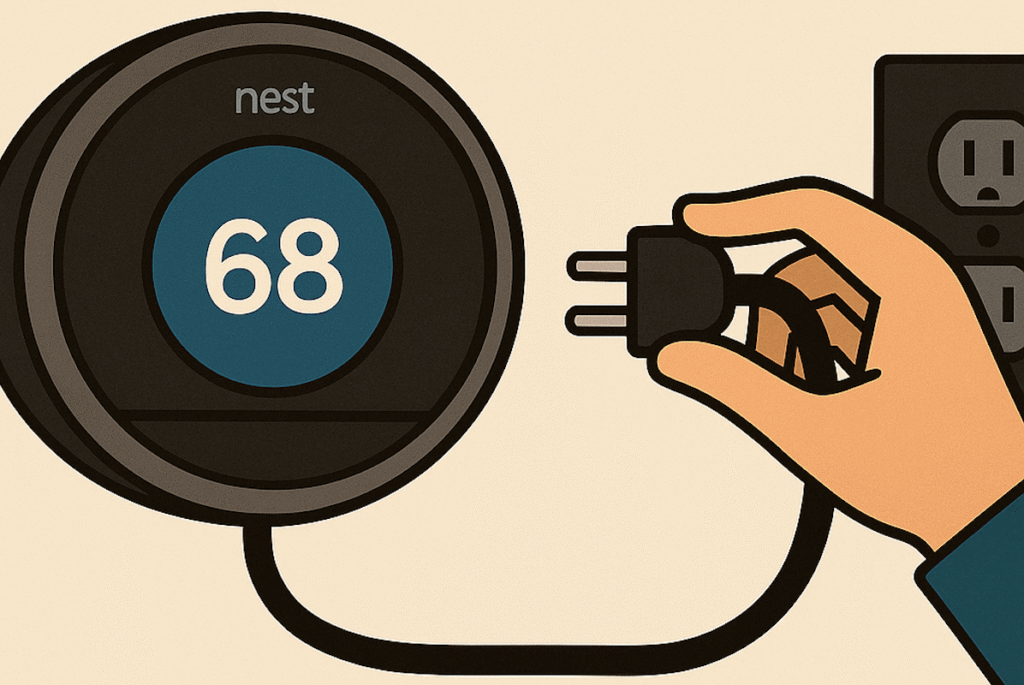
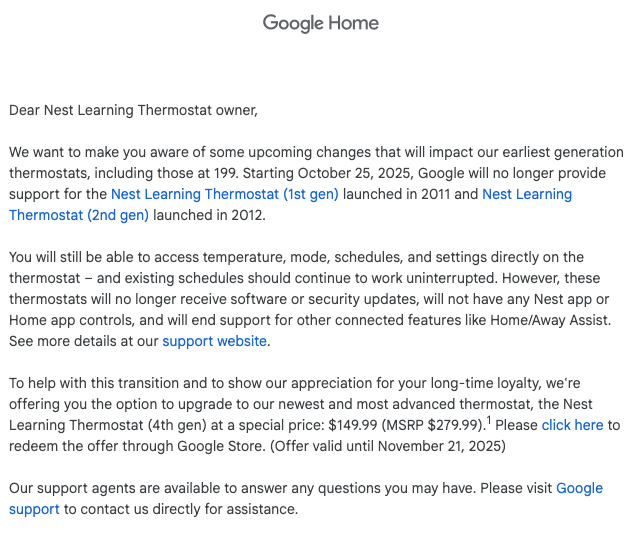
In classic Google fashion, the company has quietly announced that it will discontinue support and remote access for the original Nest Learning Thermostat (Gen 1 and Gen 2). For many homeowners who adopted Nest early, this feels like déjà vu: another example of a tech giant “sunsetting” a perfectly good product.
What It Means for Consumers:
If you own one of the early Nest Learning Thermostat models – Gen 1 or Gen 2 – your device isn’t suddenly turning into a brick. It will still control the temperature in your home. You can still walk up to it, turn the dial, and adjust the heat or cooling manually. The screen will still light up. It’ll still look smart on your wall.
But that’s about where the “smart” part ends.
When Google flips the switch, your thermostat will lose its Wi-Fi connection and access to the Nest app. That means:
- ❌ No more remote control from your phone.
- ❌ No scheduling or automatic adjustments based on your habits.
- ❌ No integration with Google Home, Alexa, or any other smart home ecosystem.
- ❌ No energy reports or eco-mode automation.
In other words, it will continue to function as a stand-alone thermostat – but it will stop behaving like a smart one. You’ll have to set your temperature manually every time, just like it’s 1995 again.
For some people, that might not be a dealbreaker. If you’re home most of the time and don’t rely on remote control, it’ll still do the basics. But if you invested in Nest for the convenience – pre-heating your house before you get home, adjusting settings from vacation, or tracking energy use – those features will simply vanish.
To make matters worse, the app will likely display connection errors, and the thermostat may periodically try (and fail) to reach Google’s servers. There’s no local control option or open-source workaround – the cloud dependency is hard-coded.
In short, you’ll still have a beautiful, circular piece of hardware on your wall but it’ll be a relic of what used to be one of the best examples of the smart home era.
Why Google Might Be Doing This:
Let’s be honest: this decision is part business strategy, part ecosystem control – and it’s hardly unique to Google. Supporting older hardware costs real money. Every legacy product requires server maintenance, firmware updates, security patches, customer support, and integration testing with newer systems. Over time, that becomes a logistical headache and a financial drain for a company built on scale and efficiency.
But this isn’t just about reducing costs. It’s about consolidation and control within Google’s smart home universe. The company has been steadily migrating everything from the old “Nest” ecosystem into its unified Google Home platform, which offers tighter integration with Assistant, Matter, and the broader Google account infrastructure. The fewer old devices floating around, the easier it is for Google to manage a single, streamlined experience – one that fits its long-term product roadmap.
There’s also the data dimension, which can’t be ignored. Newer devices collect richer and more standardized data, helping Google refine user behavior models, energy optimization algorithms, and, yes, advertising and product targeting insights. That data – how often you adjust your thermostat, when you’re typically home, how energy-efficient your patterns are – is incredibly valuable. The more devices they can migrate into the latest system, the cleaner and more consistent that data becomes.
And finally, there’s the optics. By nudging consumers toward newer products, Google can tout an ecosystem that’s “faster, more secure, and better integrated.” It’s a familiar narrative in tech: what’s framed as a user benefit often doubles as a way to reset the company’s hardware baseline and shed the cost of legacy support.
In other words, this isn’t just a case of Google moving on from an old product — it’s about simplifying their ecosystem, reinforcing their platform strategy, and deepening their data pipeline. Whether that’s innovation or manipulation depends on which side of the thermostat you’re standing on.
My Take:
I get it from a business standpoint. Hardware ages, platforms evolve, and at some point, the cost of maintaining support for older devices outweighs the revenue they bring in. It’s the same story we’ve seen in phones, laptops, even cars with software-based systems. From a corporate perspective, it’s efficient.
But as a consumer – and someone who actually bought into the promise of the smart home early – it’s hard not to feel like this breaks an unwritten contract. When we choose connected devices over their “dumb” counterparts, we’re buying more than a gadget. We’re buying into a relationship – one that assumes the company will continue to provide updates, compatibility, and some level of longevity.
What makes this particularly frustrating is that the hardware itself isn’t the problem. My Nest still works beautifully. It knows my schedule. It learns my habits. It regulates the temperature better than most new thermostats. The only thing that’s changed is Google’s willingness to keep talking to it.
And that’s what stings: the idea that a perfectly good, functional device can lose its value overnight because a company decided to move on. It’s planned obsolescence dressed up as “innovation.”
In the end, it raises a bigger question about the future of “smart” devices. Are we actually making our homes smarter – or just more dependent on the whims of tech giants? Because right now, the smartest device in my house might just be the one that isn’t connected to the cloud.
Next in the Series:
In the next post, I’ll share my own experience dealing with this change – and how frustrating it is to be forced into an upgrade I didn’t need (or want).
👉 Read next: When “Smart” Becomes Stupid: My Forced Upgrade Experience with Google Nest